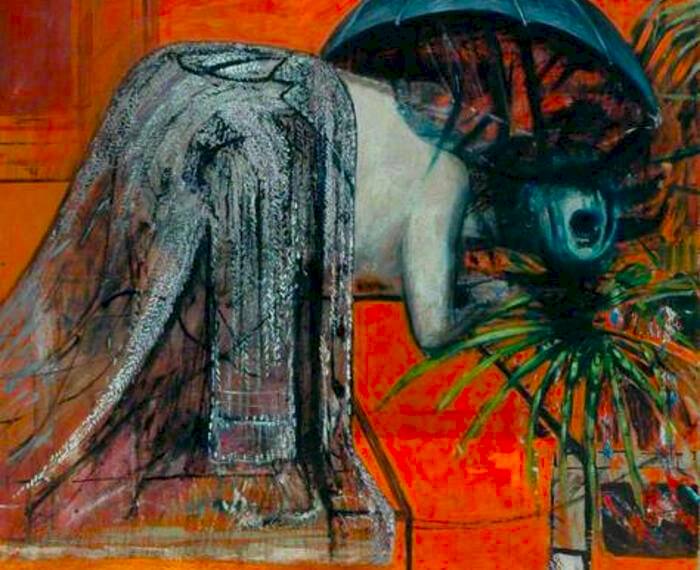
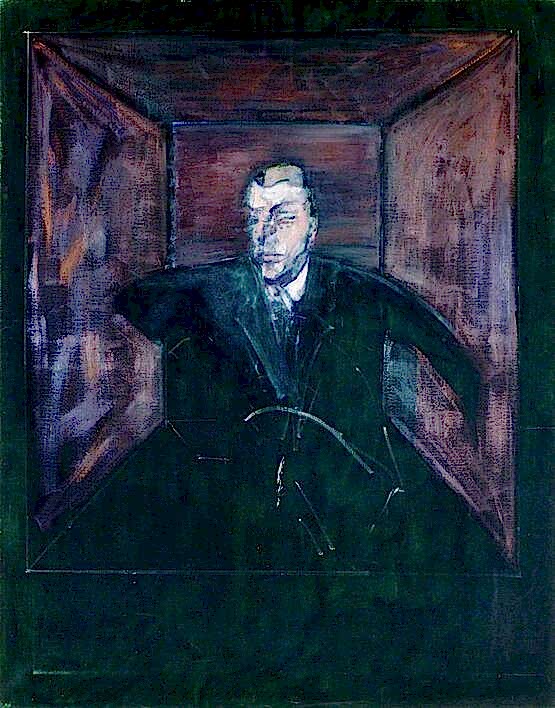
Pope I (Study after Pope Innocent X by Diego Velázquez) (1951) is a painting by Francis Bacon, a variant of his series of works inspired by Diego Velázquez's Portrait of Pope Innocent X (around 1650 in the Galleria Doria Pamphilj, Rome) which he would have only seen from postcards although a smaller half-length version of which has been in Apsley House, London (Duke of Wellington collection) since 1947. It depicts a distorted, anguished figure resembling a pope, seated in a cage-like structure, conveying a sense of unease and psychological tension.
The art critic Andrew Graham-Dixon wrote on the occasion of it being lent to the exhibition, London: An Artistic Crossroads, Sotheby's, London (2024):
"An authority figure from the distant past has been not so much reworked as put through a pictorial mangle - and subjected, in the process, to multiple indignities. Bacon has endowed his pseudo-Pope with a pair of owlish spectacles and given him a mouth frozen as if by a recent dental operation or the compulsive tic of a paralysed muscle. An umbilical cord - or is it a circus high wire? - has been coiled under his throne, which is also encased in what looks like a glass box, evoking the booths occupied by the Nazis accused of war crimes at the trials in Nuremberg.
Bacon's extreme and carnivalesque distortions of Velazquez's portrait were created, it might be argued, in response to qualities implicit in the original. Innocent X himself is said to have commented that it was troppo vero - too true to life - and for all its splendour of costume and setting, Velazquez's picture remains memorable, above all, for the revealing humanity of the sitter's expression: a look in which suspicion, volatility of temperament, and the calculating instincts of a master of realpolitik uneasily coexist.
It was that sense of a gap, between the image of power and its dark human embodiment, that fascinated Bacon; and it was his instinct to widen that gap so far that it became a yawning chasm. The result was an image at once absurd and appalling, with an implied charge of meaning that could hardly have been more topical in a postwar world still traumatized by the revelation of what had gone on in places such as Dachau, Auschwitz and Buchenwald. The abuse of power leads to atrocities."