Chantal Joffe is an American-born British artist known for her psychologically incisive portraits of friends, family, and herself. Using bold, expressive colour and gestural mark-making, her direct, unflinching gaze explores intimacy, vulnerability and the complexities of women’s experiences. Joffe was elected a Royal Academician in 2018, and in 2022 she was commissioned by Art on the Underground to create a large-scale permanent work for Whitechapel station in London, extending her portraiture into the public realm.
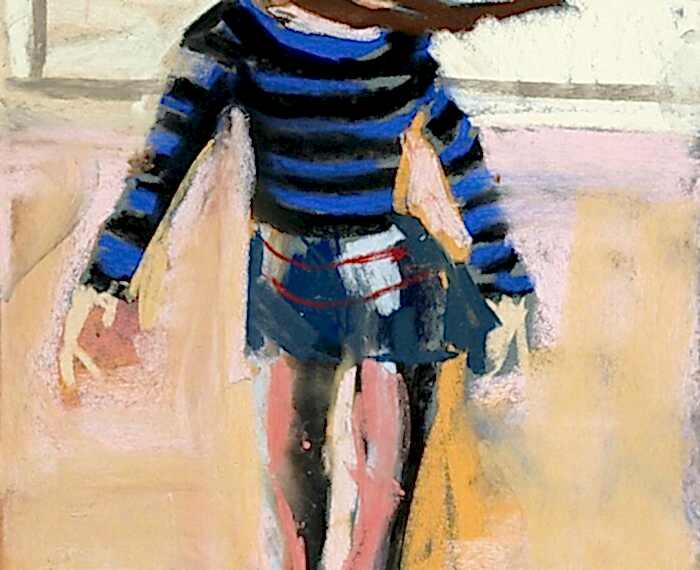
Joffe began working with pastels in 2015, recognising the possibilities the medium opened up for her practice: ‘I got more and more obsessed with [pastels]… the fast hit of the colour, the brightness’. Working with sanded paper, whose rough tooth grips the pastel pigment and holds it within its textured surface, Joffe scores dense, saturated passages of colour.
In this drawing, Joffe echoes Woman Bathing in a Shallow Tub (1885) by Edgar Degas (1834-1917) at the Metropolitan Museuem of Art, New York but places herself in the role of the bather. It belongs to a series began in 2015 in which the artist attempts to redraw Degas’s works from memory in charcoal, sometimes with her eyes closed. Gradually, Joffe shifted the focus inward: her own body became the subject, within the intimate space of her bathroom. Placing herself in Degas’ poses collapsed the role of artist and model. Describing the experience, Joffe reflected, ‘The closer I got to him, the more immersed I became in them, until I felt like I became both him the artist and the woman being drawn’.
When Degas exhibited his bathers at the eighth and final Impressionist exhibition in 1886, critics were appalled by their awkward, inelegant poses. To Joffe, however, they were compelling in their frank and intimate glimpses of everyday domesticity. ‘I found them incredibly exciting – myself seen from behind, crouching, bending, looking at a foot, drying myself’. Engaging with Degas’s drawings offered Joffe a new means of interrogating herself through inhabiting another’s identity): ‘I’m wearing the mask of Degas to make something new and modern about my own life’.
The British Museum’s Department of Prints and Drawings comprises over two million prints and 50,000 drawings and has served as a site of inspiration for artists for centuries. Although Joffe’s engagement with Degas had begun several years earlier, and she knew of his use of an apple-green ground under paintings and drawings she saw an example for the first time in 2018, when she visited the British Museum to see Degas’s Dancers at the Barre (about 1876-77). Joining the eighteen prints and twelve drawings by Degas in the collection, the acquisition of Joffe’s pastel brings this artistic dialogue full circle. This is the first work by Joffe to enter the British Museum’s collection.
(Text by Isabel Seligman, Monument Trust Curator of Modern and Contemporary Drawin)