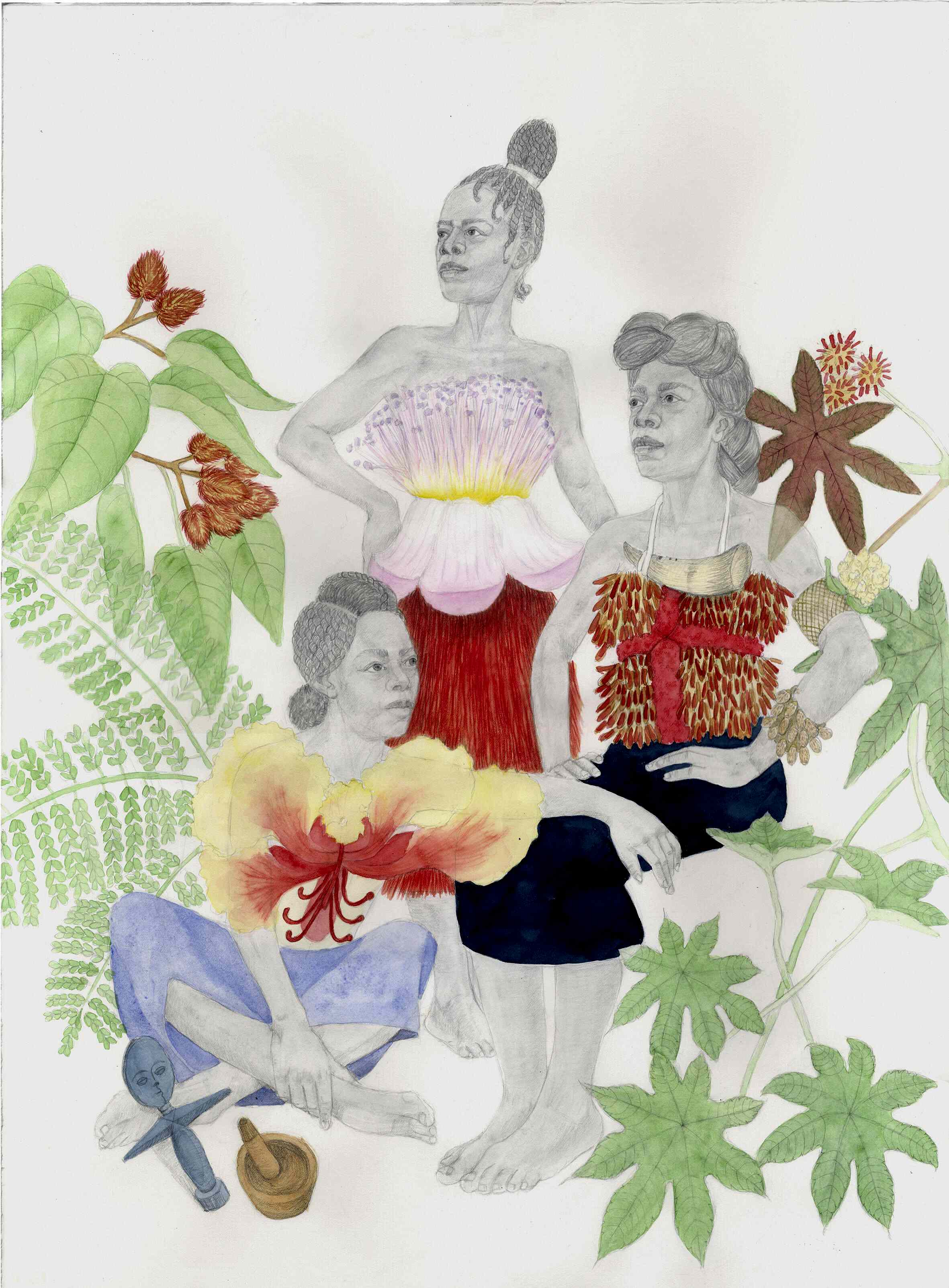
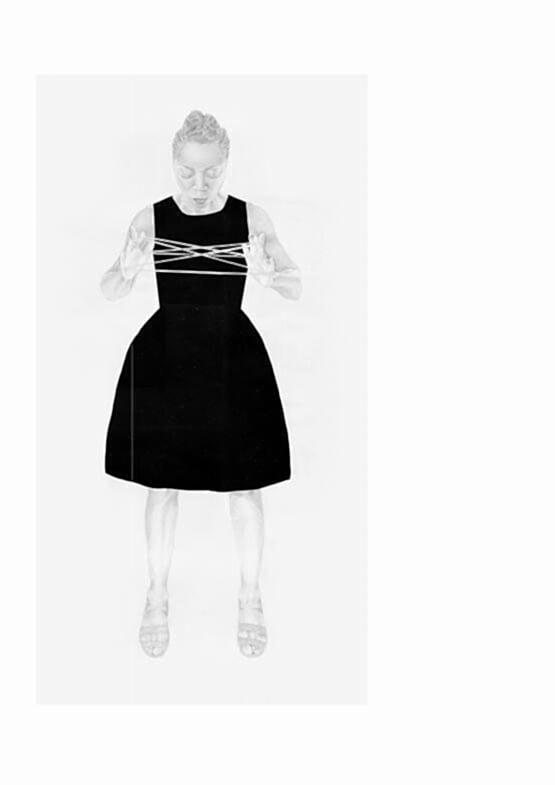
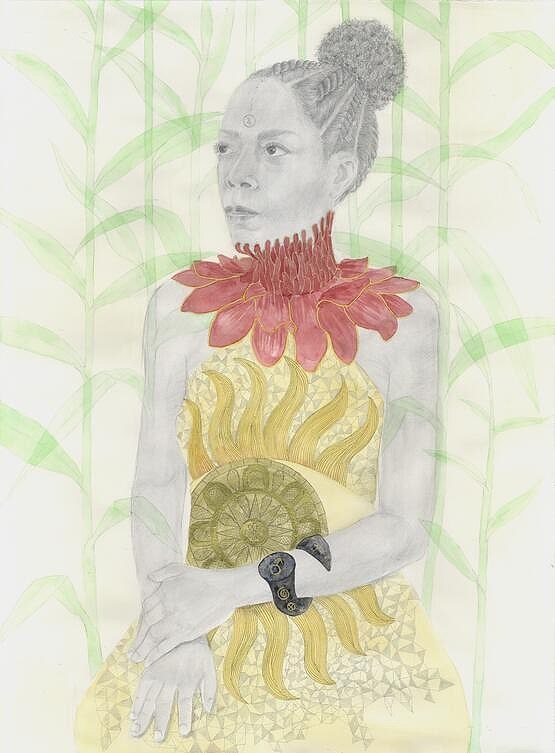
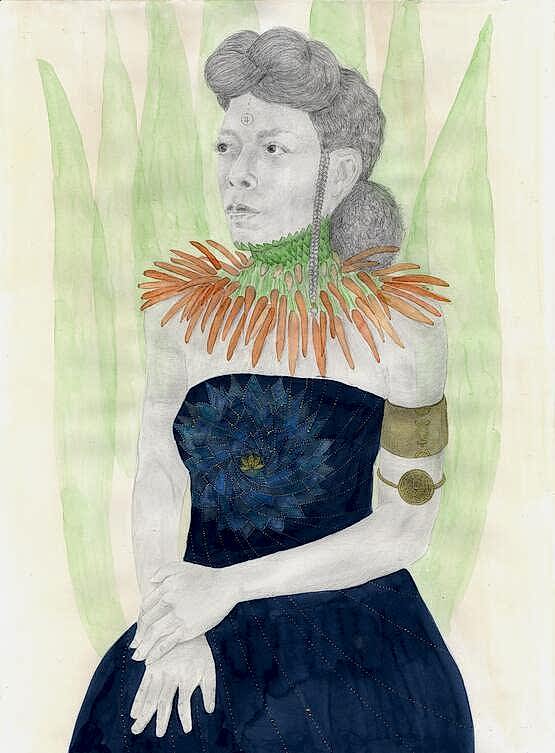
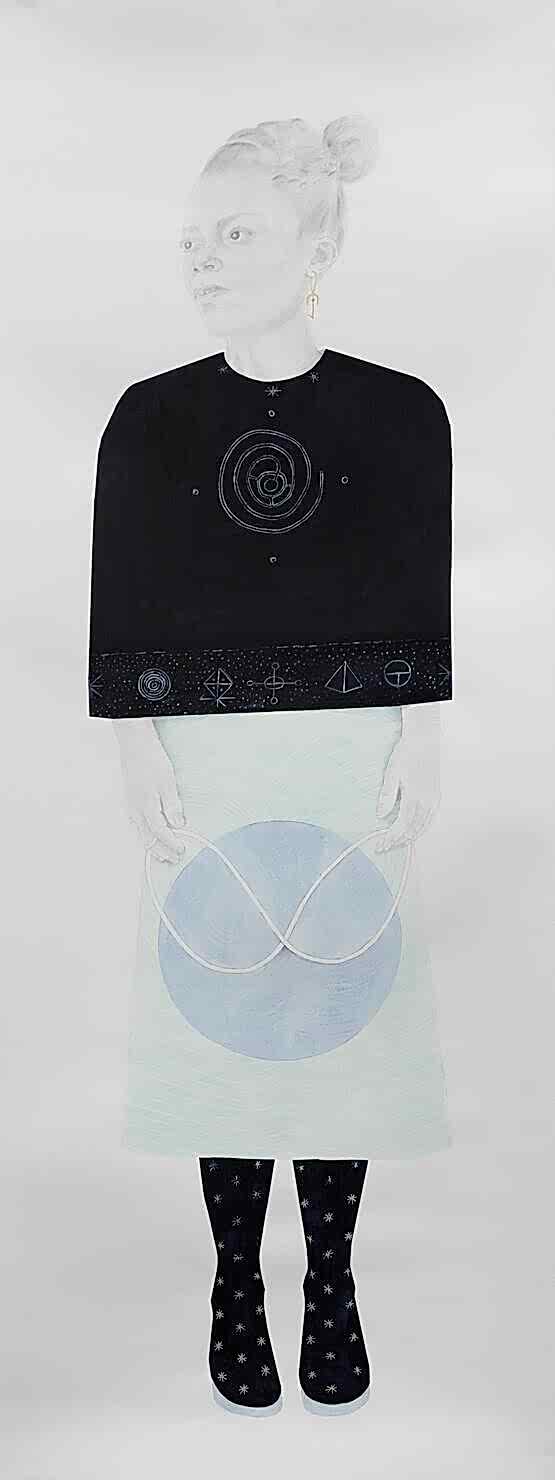
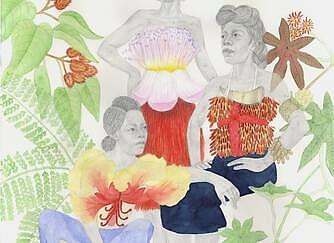
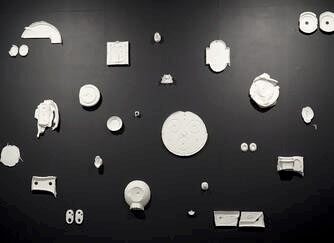
Charmaine Watkiss creates narratives, or ‘memory stories’, through research connected to the African-Caribbean diaspora, which is then mapped onto female fi gures, often using her own likeness to explore themes of resilience and empowerment. Her practice addresses themes including ritual, tradition, ancestry, mythology and cosmology, often explored through the language of plants and their properties. In particular, Watkiss has been investigating the herbal healing traditions of Caribbean women; especially those of her mother’s generation and connecting those traditions through colonisation back to their roots in Africa.
The Knowledge Pool (2024) is from a series of new works created for her solo show Legacy which was on show at Abbot Hall Gallery, Kendal, in 2024. The work has been informed by her extensive research into historic botanical collections, including a recent fellowship responding to the work of naturalist, physician and slave-owner Sir Hans Sloane (1660–1753). Considering today’s urgent ecological crises, the work acts as a reminder of the perpetual loss of biodiversity and cultural diversity, while emphasising the importance of both to our future survival. Watkiss’s interaction with plants and nature not only speaks to our need to exist more harmoniously with nature, but also chimes with the situation of The Holburne Museum locally. It is surrounded by nature in its position at the entrance to the only surviving Georgian pleasure gardens in the UK, where, in the 18th century, health visitors would come to the city to ‘take the waters’ and walk in the gardens.
The work also resonates with themes found within the museum itself, which at its heart contains the collection of Sir Thomas William Holburne (1793–1874). This was left as a bequest to form ‘the nucleus of a Museum of Art for the city of Bath’. In recent years, particular consideration has been given to acquiring works which help to explore histories that have previously been underrepresented in the collection and to better connect the historic collection with contemporary art and culture. This includes a commitment to exploring the histories and legacies of the Holburne’s connections to colonisation and the trans-Atlantic slave trade. William Holburne’s ancestors were involved in the plantation economy of the Caribbean, which entailed the use of enslaved labour, and both Holburne himself and, later, the Museum benefitted financially from that involvement. The addition of The Knowledge Pool to the Holburne’s collections helps to explore these troubling histories while also celebrating cultural legacies and endurance.
(Text by Eleanor Hutchison, Curator, The Holburne Museum, Bath)